

Step-by-Step Guide to Energy Saving Cooktops
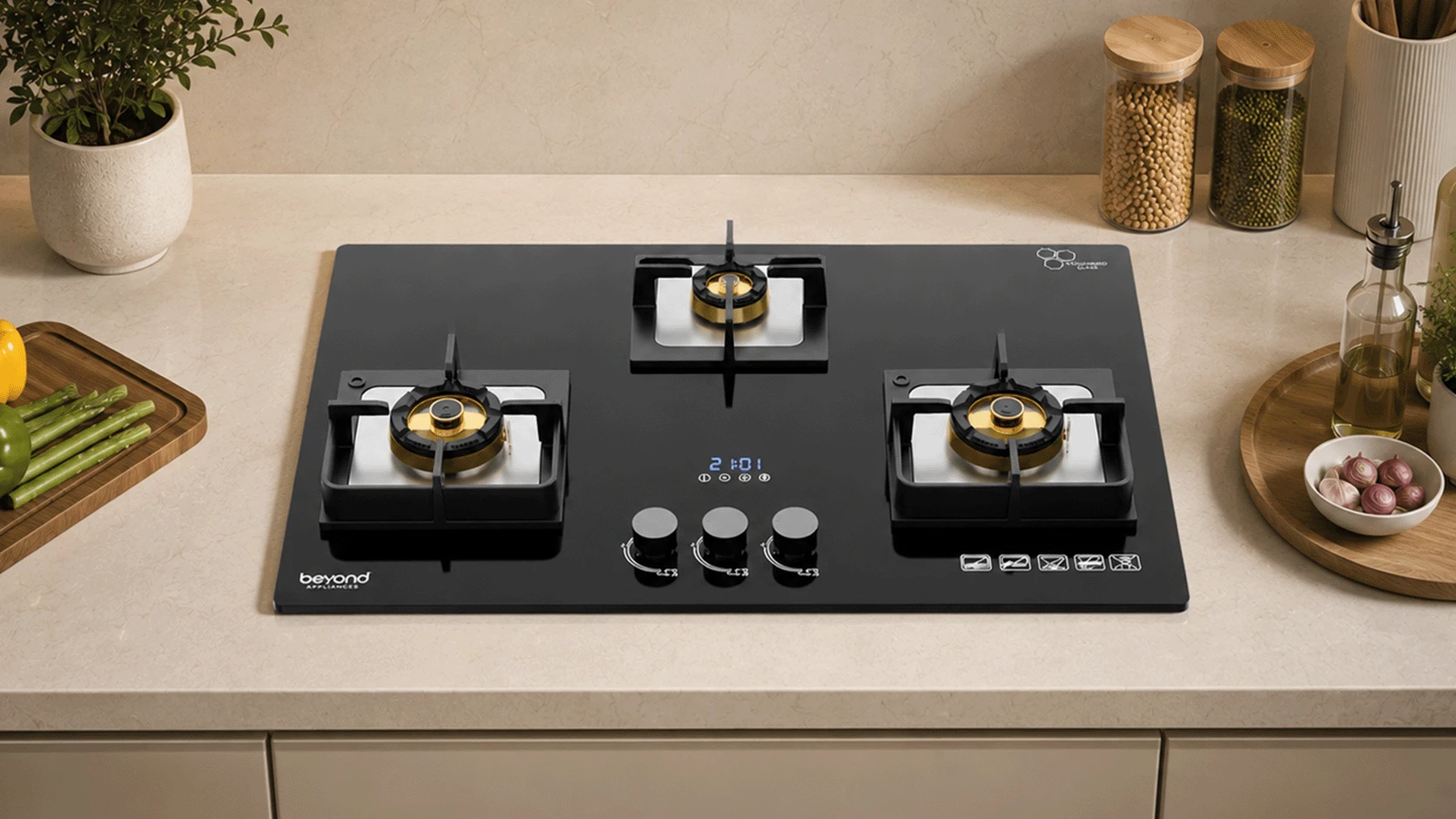
Every time you cook, your cooktop is either working for you or against your electricity bill. In Indian households, cooking accounts for a significant share of daily energy use — and the cooktop you choose plays a bigger role than most people realise. Cooktops for energy saving work by transferring maximum heat directly to your cookware while wasting as little energy as possible. Induction cooktops lead with 85–90% efficiency, electric smooth-top models follow at around 74%, and gas cooktops convert only about 40% of their energy into usable heat. This guide walks you through how to understand, choose, and use an energy-efficient cooktop — including where gas cooktops with smart features, like those in the Beyond Appliances range, still make strong practical sense for Indian cooking.
Induction cooktops are the most energy-efficient at 85–90%, followed by electric at ~74% and gas at ~40% — but smart gas cooktops with features like FFD and timers can significantly reduce waste.
Choosing the right wattage, BEE star rating, and utensil type for your household size is the fastest way to cut your monthly cooking costs.
Ten simple habits — from using lids to batch cooking — can reduce your cooktop energy usage by up to 30%, regardless of which type you own.
Most people compare cooktops by upfront cost or looks. But the number that actually affects your monthly bill is energy efficiency — how much of the energy consumed actually reaches your food. Understanding this helps you make a smarter purchase decision from the start.
Cooktop efficiency is measured as a percentage of energy converted into usable heat. A gas cooktop rated at 40% efficiency means 60% of the gas burned escapes into the surrounding air. An induction cooktop at 90% efficiency means almost all the electricity drawn goes directly into heating your cookware.
Efficiency is calculated by comparing the heat energy that reaches the cookware against the total energy consumed. For electric and induction cooktops, this is measured in watts. For gas, it is measured in the calorific value of LPG burned. The Bureau of Energy Efficiency (BEE) star rating system in India translates this into a simple 1–5 star label — the higher the star rating, the lower the annual energy consumption. As a general approximation for gas cooktops in the Indian market, each additional BEE star reduces energy consumption by approximately 10–15%.
Here is a quick reference for cooktop efficiency by type:
Gas cooktop: approximately 40% efficient
Electric coil or smooth-top: approximately 74% efficient
Induction cooktop: 85–90% efficient
Use this simple formula to estimate your daily cooking cost: (Wattage ÷ 1000) × Hours Used × Electricity Rate = Daily Cost in ₹. For example, a 2000W induction cooktop used for 1.5 hours per day at ₹8 per unit costs approximately ₹24 per day, or around ₹720 per month. Compare that to a less efficient cooktop running longer to achieve the same result, and the savings become clear over time.
Cooktop Type |
Avg. Wattage |
Efficiency |
Est. Monthly Cost (1.5 hrs/day at ₹8/unit) |
|---|---|---|---|
Gas (LPG) |
— |
~40% |
Varies by cylinder usage |
Electric Coil |
1500W |
~74% |
~₹540 |
Induction (1200W) |
1200W |
~85% |
~₹432 |
Induction (2000W) |
2000W |
~90% |
~₹720 (but cooks faster) |
Each cooktop type has a different energy profile. The right choice depends on your cooking style, kitchen setup, and how much you are willing to invest upfront versus save over time. Here is how each type performs on energy efficiency — and how to get the most out of whichever you own.
Gas cooktops lose roughly 60% of their heat to the surrounding air. That said, they remain the preferred choice for high-volume Indian cooking — tempering spices, high-heat stir-frying, and cooking on large vessels. The key is reducing waste through smart habits and choosing a model with features that prevent unnecessary gas flow.
Five practical gas cooktop energy saving tips:
Match the burner size to your pan — an oversized flame heats the air, not the food
Always cook with a lid on to trap heat and reduce cooking time
Avoid preheating unless the recipe specifically requires it
Use a pressure cooker for lentils, beans, and grains — it cuts gas use by up to 70%
Keep burner caps clean — clogged caps create uneven flames and waste gas
Models like the Beyond Appliances Quantum Gas Saver Stove are built specifically around this problem. It carries a 5-star BEE energy rating, uses HEXA Technology to achieve 77% energy efficiency as rated by Beyond Appliances, and is rated to save up to 2 LPG cylinders per year compared to standard gas stoves. Its Flame Failure Device (FFD) automatically cuts the gas supply if the flame goes out — preventing unburned gas waste and improving safety. For households that cook on gas daily, this kind of built-in efficiency makes a measurable difference to the monthly cylinder bill.
Electric cooktops are more efficient than gas but require flat-bottomed cookware for maximum heat contact. One useful habit is turning off the cooktop 2–3 minutes before the food is done — the residual heat in the coil or glass surface continues cooking without drawing power. Certified high-efficiency models can deliver meaningful savings over their lifetime compared to uncertified alternatives, adding up to a significant difference across the product's lifespan.
Induction cooktops use electromagnetic technology to generate heat directly inside the cookware — not on the surface. This eliminates almost all wasted heat. At 85–90% efficiency, they are the clear leader among cooktops for energy saving. They also heat up faster, which means less time cooking and less total energy consumed per meal. There are no combustion gases, which also improves indoor air quality — a real benefit in compact urban kitchens.
The one requirement: your cookware must have a magnetic base. Cast iron, magnetic stainless steel, and induction-compatible non-stick pans all work. Aluminium, copper, and standard glass cookware do not, unless they have a magnetic base layer built in.
Is induction cheaper than LPG? In most Indian households, yes — when electricity costs are below approximately ₹10 per unit. With LPG cylinder prices rising steadily and induction efficiency at 85–90% versus gas at ~40%, induction cooking typically costs less per meal for an average family cooking two to three times daily.
Choosing the right cooktop is not just about picking the most efficient type. It is about matching the appliance to your actual cooking habits, household size, and kitchen setup. Follow these five steps before making a purchase decision.
Your household size directly determines the wattage and burner count you need. A small family of one to two people can manage well with a 1200W–1500W induction cooktop or a 2-burner gas model. A medium family of three to four people benefits from 1800W–2000W induction or a 3-burner gas cooktop. Larger families or those who cook frequently should consider 2000W+ induction or a 4-burner gas hob with a high-output jumbo burner.
The BEE star label on a cooktop tells you its annual energy consumption in kWh. A 5-star model consumes significantly less energy than a 1-star model of the same type. Each additional star typically reduces energy consumption by 10–15%, as a general approximation for gas cooktops in the Indian market. Low energy consumption cooktops typically carry a 4- or 5-star BEE rating and are the most cost-effective choice over a 3–5 year ownership period. While 5-star models may cost more upfront, they generally recover the price premium within 12–18 months through lower running costs — making them the smarter long-term investment.
Lower wattage does not always mean more efficient. An underpowered cooktop takes longer to cook the same meal, consuming more energy overall. Here is a practical guide:
Daily Indian cooking (curries, rice, dal): 1800W–2000W
Boiling, deep frying, high-heat cooking: 2000W and above
Simmering, slow cooking, warming: 1200W–1500W
Before switching to induction, test your existing cookware with a magnet. If the magnet sticks firmly to the base, the cookware is induction-compatible. If not, factor in the cost of replacing incompatible pots and pans when calculating total purchase cost. Gas and electric cooktops work with all flat-bottomed cookware, making them more flexible if you have a mixed set of vessels.
Smart features are not just about convenience — they directly reduce energy waste. Look for these when comparing models:
Auto-shutoff or FFD: Cuts power or gas supply automatically when the flame goes out or cooking is complete
Digital or smart timer: Prevents overcooking and eliminates the need to monitor the cooktop continuously
Preset cooking modes: Reduces guesswork and prevents overheating
Keep-warm mode: Maintains temperature at minimal power rather than active heating
The Beyond Appliances Solaria Gas Cooktop, for example, combines a Smart Timer, FFD, Auto Ignition, and premium 8mm toughened glass in a mid-range package. The timer prevents gas from running longer than needed, and the FFD ensures the gas supply cuts off the moment a flame is accidentally extinguished — two features that directly reduce both energy waste and safety risk. Similarly, the Auriga Gas Cooktop brings a Digital Timer and FFD to a budget-friendly price point, making energy-saving features accessible without a premium spend.
The cooktop you choose matters — but how you use it matters just as much. These ten habits work across gas, electric, and induction cooktops and can reduce your overall cooking energy usage by up to 30%.
Use the right-sized burner or zone — Oversized burners waste 20–30% of energy heating empty air around the pan
Always cook with a lid on — Trapping steam reduces cooking time by up to 25%
Defrost food before cooking — Frozen food requires significantly more energy to bring to temperature
Use residual heat — Turn off electric or induction cooktops 2–3 minutes before the food is fully done
Pressure cook when possible — Cuts energy use by 50–70% for lentils, beans, and grains
Batch cook — One longer cooking session uses less total energy than multiple short ones
Keep cooktop surfaces clean — Residue on burner caps or glass surfaces reduces heat transfer efficiency
Minimise preheating — Induction and electric cooktops require little to no preheating time
Use flat-bottomed cookware — Maximises contact with the heat source and improves transfer efficiency
Choose the right cookware material — Stainless steel and cast iron retain heat well, reducing active cooking time per meal
Energy efficiency is not just about your electricity bill. Every unit of energy wasted in the kitchen has an environmental cost. Choosing an eco-friendly cooktop — and using it well — reduces both your carbon footprint and your long-term household expenses.
Gas cooktops produce direct CO₂ and methane emissions during combustion. Electric cooktops produce indirect emissions that depend on the energy mix of the local power grid. Induction cooktops powered by renewable energy sources produce near-zero cooking emissions. As India's grid increasingly incorporates solar and wind energy, induction cooking becomes progressively cleaner over time — without any change to the appliance itself.
A cooktop that wastes 60% of its energy does not just cost more to run — it represents a cumulative financial and environmental loss over its lifetime. Over five years, the difference in running costs between a low-efficiency and a high-efficiency cooktop can easily exceed the original purchase price difference. Upgrading to an energy-efficient model is an investment that pays back, not an added expense.
When evaluating cooktops on environmental grounds, there is more to consider than the energy label alone. Beyond Appliances models like the Quantum Gas Saver Stove are designed with these factors in mind:
BEE 5-star rating or equivalent energy certification
Durable build quality — a longer-lasting appliance means less manufacturing waste over time
Low standby power consumption
Toughened glass thickness (8mm glass is more durable and less likely to need early replacement than 6mm)
The Beyond Appliances Quantum Gas Saver Stove is a strong example of eco-conscious design in the gas cooktop category. Its 5-star BEE rating and 77% energy efficiency — achieved through HEXA Technology, as rated by Beyond Appliances — mean it extracts significantly more usable heat from each unit of LPG than a standard gas stove. The 10-year comprehensive warranty also reflects the kind of build durability that reduces long-term waste.
Induction cooktops are the most energy-efficient, converting 85–90% of electrical energy directly into heat inside the cookware. Electric smooth-top cooktops operate at around 74% efficiency, and gas cooktops at approximately 40%. For households focused on minimising cooktop energy usage, induction is the clear leader in both speed and efficiency.
In most Indian households, induction cooking is cheaper per meal when electricity costs are moderate. Gas cooktops convert only about 40% of LPG into usable heat, while induction operates at 85–90% efficiency. With LPG cylinder prices rising steadily, induction has become increasingly cost-competitive for daily cooking in urban homes.
A 2000W induction cooktop is often more energy-efficient in practice because it reaches cooking temperature faster, reducing total cooking time. A 1200W model draws less power per minute but runs longer to achieve the same result. For most Indian cooking tasks, a 1800W–2000W model offers the best balance of speed and energy efficiency.
Yes — features like Flame Failure Devices (FFD), digital timers, and auto-ignition directly reduce energy waste on gas cooktops. An FFD cuts the gas supply the moment a flame goes out, preventing unburned gas from escaping. A timer stops cooking at the right moment, avoiding overuse. Beyond Appliances models like the Solaria and Auriga include both FFD and timer controls as standard, making them meaningfully more efficient than basic gas cooktops without these features.
Induction cooktops only work with magnetic-base cookware — including cast iron, magnetic stainless steel, and induction-compatible non-stick pans. Aluminium, copper, and standard glass cookware will not work unless they have a magnetic base layer. Test your existing cookware with a magnet before purchasing an induction cooktop to avoid unexpected replacement costs.
Among common kitchen appliances, induction cooktops are the most energy-efficient for cooking, operating at 85–90% efficiency. Microwave ovens are highly efficient for reheating and small portions but are not suited to full Indian meal preparation. Gas cooktops operate at around 40% efficiency. For everyday cooking in Indian households, induction offers the best combination of speed, efficiency, and running cost savings.
Choosing cooktops for energy saving is one of the most practical steps an Indian household can take to reduce monthly bills and long-term environmental impact. Induction leads on raw efficiency, but a well-designed gas cooktop with a 5-star BEE rating, FFD, and a smart timer can deliver meaningful savings — especially for kitchens built around Indian cooking habits that rely on high heat and multiple burners.
The decision comes down to three things: your cooking style, your household size, and the features that prevent energy waste in daily use. Whether you are evaluating a budget-friendly option like the Auriga, a mid-range model like the Solaria or the Dorado Gas Hobtop, a premium 4-burner hob like the Altair — which features a 10.4 kW Jumbo Burner and Smart Timer suited to large-family or high-heat Indian cooking — or a purpose-built energy saver like the Quantum Gas Saver Stove, the right cooktop is the one that matches how you actually cook — and wastes as little energy as possible doing it.
Use the checklist below as a quick reference before you buy.
Before you buy:
Calculate your current monthly cooking energy cost
Identify your household size and cooking frequency
Check the BEE star rating on shortlisted models
Verify utensil compatibility (magnet test for induction)
Compare 5-year total cost of ownership, not just purchase price
Confirm smart features: FFD, auto-shutoff, timer, and preset modes
After you buy:
Use appropriately sized cookware for each burner or zone
Enable timer and auto-shutoff features by default
Cook with lids on as standard practice
Schedule monthly cleaning for optimal heat transfer
Batch cook where possible to reduce total daily cooking time
