

Choosing Right Kitchen Exhaust: A Step-by-Step Guide
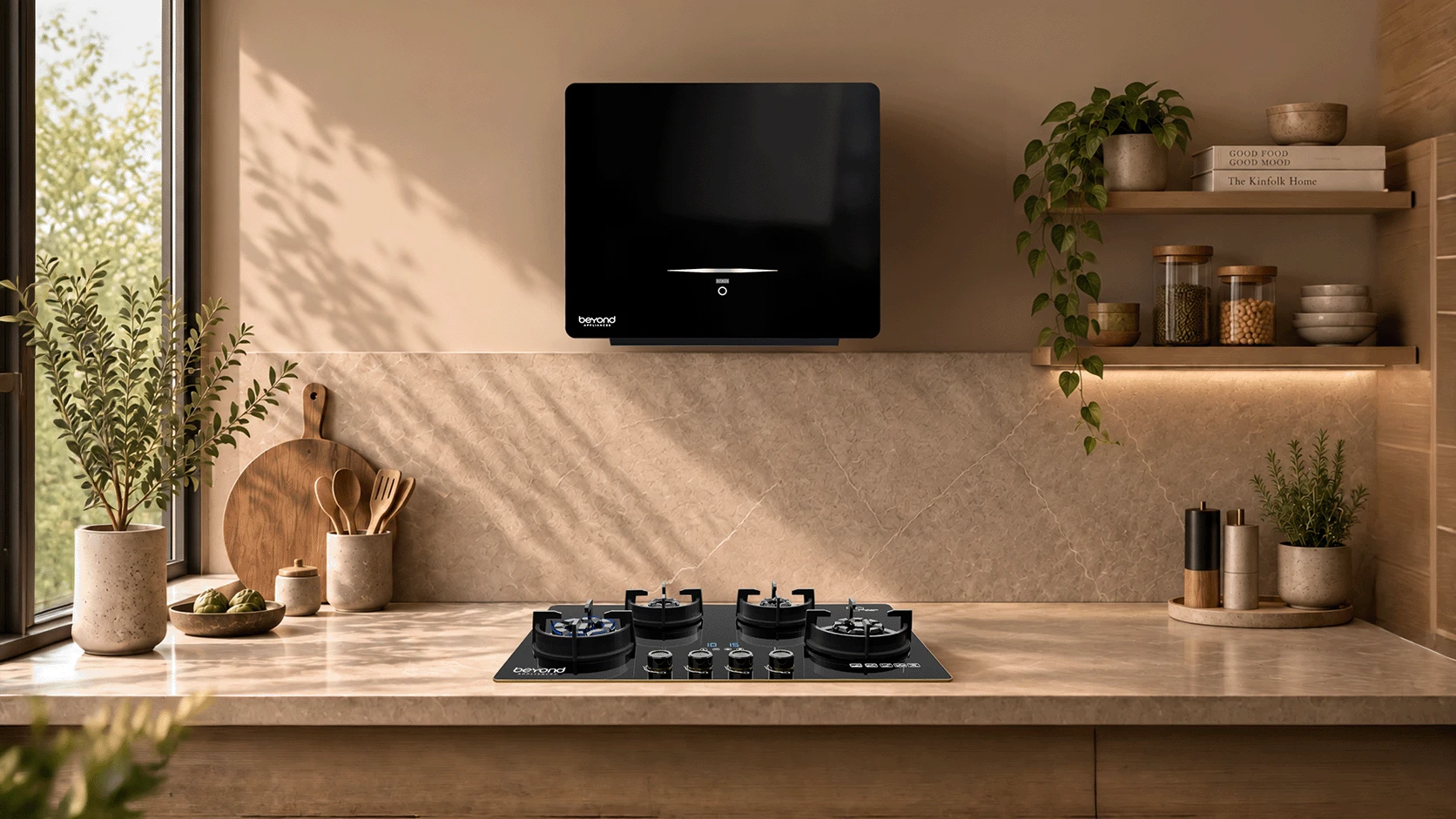
Every Indian kitchen deals with the same daily challenge: smoke, steam, and the sharp smell of tempering spices that cling to walls, curtains, and clothes. A good kitchen exhaust does more than clear the air — it protects your kitchen surfaces, keeps cooking odours from spreading through the home, and supports healthier kitchen air quality over time. Yet most buyers pick a chimney based on looks or price alone, only to find it struggling within months. Choosing the right kitchen exhaust means matching the appliance to your actual cooking habits, kitchen layout, and installation conditions. This step-by-step guide walks you through exactly that — so you can make a confident, informed decision. For instance, the ductless Plug N Play BLDC Chimney from Beyond Appliances addresses one of the most common installation constraints in Indian apartments: the need for effective suction without any wall drilling or external ducting.
Start with suction capacity — the higher your burner count and cooking intensity, the more CMH you need to keep smoke and grease from settling on your kitchen surfaces.
Choose ducted or ductless based on your kitchen's wall access — ductless models with activated carbon filters are a practical solution where external ducting is not possible.
Prioritise auto-clean technology and a strong motor warranty to cut down on long-term maintenance effort and keep your chimney performing consistently for years.
Indian cooking generates significantly more grease, smoke, and airborne particles than lighter Western cooking styles. Mustard seeds popping in hot oil, deep frying, and high-flame tadkas push large volumes of oily smoke into the air within seconds. Without effective kitchen fume extraction, this grease settles on cabinets, tiles, and appliances — causing long-term damage and creating an unhealthy cooking environment.
A properly chosen kitchen exhaust does not just remove odours. It actively pulls grease-laden air out before it can settle, keeping your kitchen cleaner and your indoor air quality measurably better. The benefits are practical and cumulative:
Reduces grease buildup on cabinet surfaces and tiles
Improves indoor air quality during and after cooking
Extends the lifespan of kitchen cabinets and appliances
Eliminates cooking odours before they spread through the home
This is why range hood selection should be treated as a functional decision, not a decorative one.
The first step in choosing the right kitchen exhaust is understanding the size of the space you are working with. Chimney width should match or slightly exceed the width of your cooktop. A 60 cm chimney suits a 2 or 3 burner cooktop placed in a standard kitchen. A 4 burner setup or a wider hob typically calls for a 90 cm chimney. It is worth noting that ductless chimney models — including the Plug N Play range — are optimised for standard 60 cm cooktop widths, and their high suction capacity (1400–1600 CMH) is designed to compensate effectively in enclosed kitchen setups.
Kitchen volume also matters. Larger kitchens with open layouts need higher suction capacity to clear air effectively. For most Indian kitchens, 1400 CMH is a practical starting point, while 1600 CMH is better suited to heavier cooking loads or larger spaces.
CMH stands for Cubic Meters per Hour — the volume of air a chimney can pull through in one hour. Here is a practical guide to help you match CMH to your cooking setup:
2–3 burners, moderate cooking: 1400 CMH is a reliable starting point
4 burners, heavy Indian cooking (frying, high-flame use): 1600 CMH for consistent performance
The Beyond Appliances Plug N Play BLDC Chimney, for instance, delivers 1600 CMH — a capacity suited to kitchens where high-intensity cooking is the norm.
This is one of the most practical decisions in the kitchen ventilation guide process. A ducted chimney vents air outside through a pipe in the wall or ceiling. A ductless chimney filters the air internally and recirculates it back into the kitchen. Both have clear use cases depending on your kitchen setup.
Ducted models are generally more efficient at removing heat and moisture. However, they require core cutting through walls, which is not always possible in apartments or rented homes. Ductless models with activated carbon filters — like the Beyond Appliances Plug N Play range — eliminate the need for core cutting entirely, making them a practical choice for kitchens where wall access is restricted.
Kitchen hoods — also referred to as range hoods or chimneys — come in several configurations, each suited to a different kitchen layout:
Wall-mounted: Fixed to the wall above the cooktop; the most common type in Indian homes
Island: Suspended from the ceiling above a central cooking island; suited to open-plan kitchens
Under-cabinet: Installed beneath an overhead cabinet directly above the hob; compact and space-efficient
Ductless / Recirculating: Filters and recirculates air internally using activated carbon; no external ducting required
If your kitchen is in an apartment, a rented space, or a layout where external ducting is not feasible, a ductless chimney with a quality carbon filter is a reliable alternative. The Beyond Appliances Activated Carbon Filter uses a 3-stage filtration system — trapping grease and oil particles, then passing air through an activated charcoal layer that absorbs cooking odours, and finally recirculating clean air back into the kitchen — delivering effective filtration without any external venting.
Filters are the part of a chimney that most buyers overlook until they face a problem. Baffle filters are durable and can be cleaned periodically. Mesh filters trap grease but clog faster and need more frequent attention. Carbon filters in ductless models need replacement every few years depending on usage.
Auto-clean technology simplifies this significantly. It uses a heating mechanism to loosen grease from the filter, which then drips into a collection cup. This reduces the frequency of manual cleaning and keeps suction performance consistent over time. Both Plug N Play chimney models from Beyond Appliances include auto-clean as a standard feature, which is particularly useful for kitchens where daily cooking is heavy.
The motor is the heart of any kitchen exhaust. A BLDC motor — Brushless Direct Current — runs quieter, consumes less electricity, and lasts longer than a conventional motor. If noise is a concern, especially in open-plan kitchens or smaller homes, a BLDC-powered chimney is worth the additional investment. Here is how the two motor types compare:
BLDC motor: Quieter operation, lower electricity consumption, longer lifespan, higher upfront cost
Conventional motor: Higher noise levels, greater power draw, lower purchase price
The Beyond Appliances Plug N Play BLDC Chimney is built around a silent BLDC motor and carries a 15-year motor warranty — a meaningful indicator of long-term reliability. The non-BLDC 1400 CMH variant from the same range offers strong suction at a lower price point but operates at a higher noise level, which is worth factoring in based on your kitchen layout and daily routine.
A chimney is a long-term investment. Warranty terms tell you a great deal about how confident a brand is in its own product. Look for separate warranties on the motor, the filter, and the overall unit — these are different components with different lifespans.
Beyond Appliances backs its Plug N Play chimney range with a 15-year motor warranty, a 4-year filter warranty, and a 2-year comprehensive warranty on the unit. Service access across approximately 20,000 locations, with support typically available within 48 hours in major cities, means that after-sales assistance is practical rather than just a promise on paper.
For a 4-burner setup with regular Indian cooking, you need a minimum of 1400 CMH — and 1600 CMH if your cooking involves frequent frying, tempering, or high-flame use. Higher suction ensures the chimney can handle peak cooking loads without losing effectiveness.
Yes. Ductless chimneys with activated carbon filters do not require any core cutting or external ducting. The Beyond Appliances Plug N Play BLDC Chimney is designed specifically for this — it requires no ducting and no wall drilling, making it suitable for apartments and rented kitchens.
This depends on cooking frequency and intensity. The Beyond Appliances Activated Carbon Filter is rated for a 4-year filter life under regular use. It is easy to self-install, so replacement does not require a service visit.
For most households, yes. A BLDC motor runs significantly quieter, uses less electricity, and has a longer operational lifespan than a standard motor. The 15-year motor warranty on the Beyond Appliances BLDC model reflects this durability advantage.
Ideally, yes. The chimney width should match or slightly exceed the cooktop width to capture smoke and steam effectively. A 60 cm chimney pairs well with a 2 to 3 burner cooktop. A 4-burner hob or wider cooktop typically benefits from a 90 cm chimney.
The best kitchen exhaust depends on three key factors: your required suction capacity (matched to burner count and cooking intensity), whether you need a ducted or ductless model based on your kitchen's wall access, and the motor type for noise and efficiency. For most Indian kitchens — particularly apartments where wall drilling is not an option — a ductless chimney with a BLDC motor and high CMH rating offers the most practical combination. The Beyond Appliances Plug N Play range, available in 1400 CMH and 1600 CMH variants, is designed specifically around these requirements for Indian cooking conditions.
Choosing the right kitchen exhaust comes down to four practical factors: suction capacity matched to your cooking load, ducted versus ductless based on your kitchen's physical constraints, filter type and auto-clean capability for long-term maintenance, and motor quality backed by a meaningful warranty. Getting these right means your chimney will perform consistently for years — not just in the first few months after installation.
For kitchens where ducting is not an option, ductless models with quality carbon filtration offer a genuinely effective alternative. For buyers who cook heavily and want minimal maintenance, auto-clean technology and a BLDC motor are worth prioritising. And for anyone setting up a new kitchen or renovating an existing one, pairing the right chimney with a well-matched cooktop creates a setup that is both safer and easier to manage day to day. The Beyond Appliances Solaria and Auriga cooktops, for example, both include a Flame Failure Device and auto-ignition as standard — safety features that complement the Plug N Play chimney range for a complete, well-ventilated kitchen setup.
